Large Format Printing Dubai: Media, Uses & Expert Guide
 THE RPS LLC
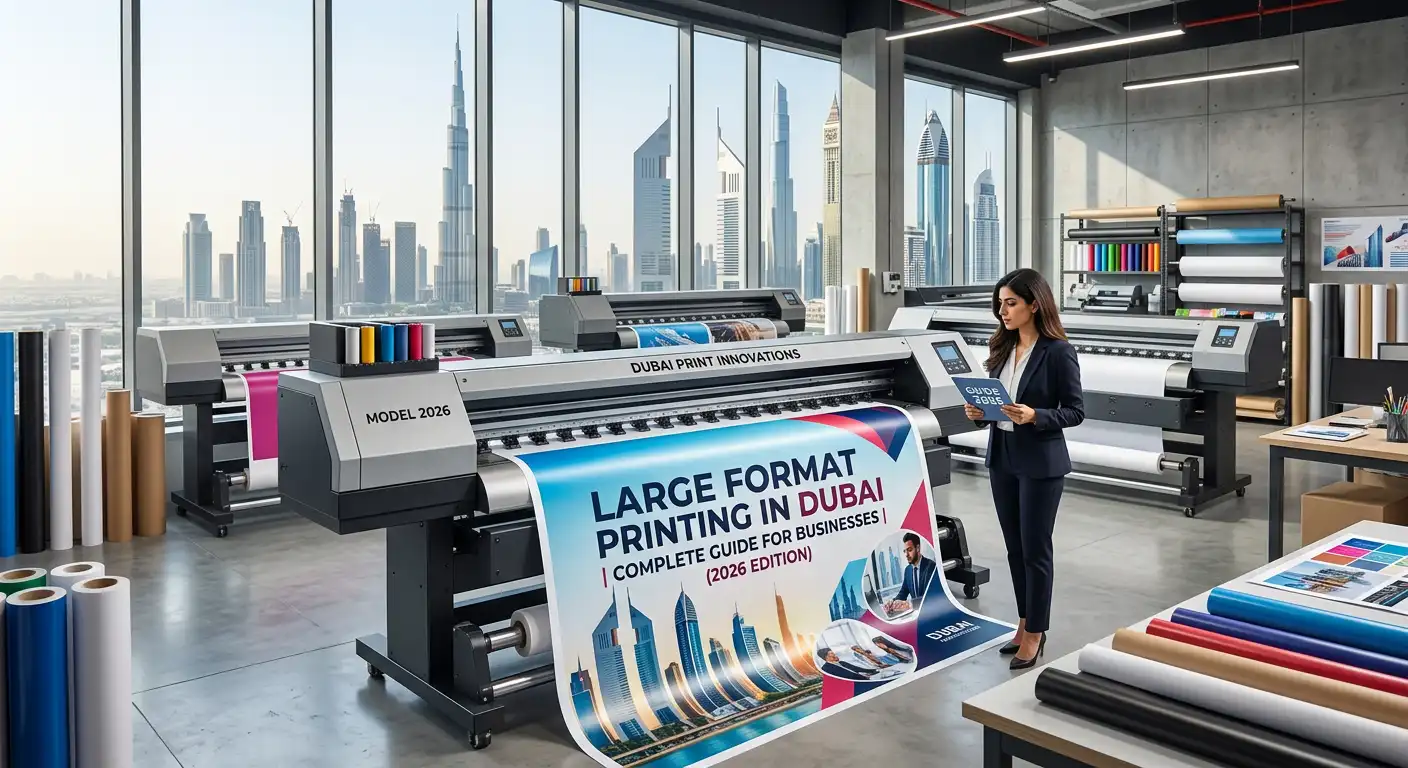
Walk through a trade show, shopping mall, airport, retail store or city center and you will see large format printing everywhere. The giant banner above a storefront. The wall graphic covering an office reception.…
Walk through a trade show, shopping mall, airport, retail store or city center and you will see large format printing everywhere.
The giant banner above a storefront. The wall graphic covering an office reception. The oversized poster at an exhibition. The graphics wrapped around a delivery van. Even the promotional backdrop people are taking photos in front of.
These are all common applications of large format printing.
But choosing a large print is not simply a matter of taking a normal design and making it bigger. The material, artwork resolution, print technology, viewing distance, finishing and installation all affect how the final graphic looks and performs.
This guide explains what large format printing is, how it works, the most common sizes and materials, what it costs, and what you should know before sending a large-format project to print.
What Is Large Format Printing?
Large format printing is a printing process used to produce graphics that are too large for conventional desktop or standard commercial printers.
It is also commonly called wide format printing.
HP describes large-format printing as printing on media over 24 inches wide and notes applications ranging from banners and vehicle wraps to detailed technical drawings. You can read HP’s overview of the large format printing process for a more technical explanation. Large Format HP
Unlike ordinary document printing, large format printing is designed to produce graphics that may need to be viewed from several feet—or sometimes hundreds of feet—away.
Typical applications include:
- Banners and posters
- Wall murals and wall graphics
- Window graphics
- Exhibition displays
- Retail graphics
- Event backdrops
- Vehicle graphics
- Construction hoarding
- Canvas prints
- Floor graphics
- Outdoor advertising
- Large promotional signage
The final print can range from a relatively small promotional poster to graphics covering an entire wall, vehicle or building surface.
Large Format Printing vs. Wide Format Printing
You will often see the terms large format printing and wide format printing used interchangeably.
For most customers, there is little reason to worry about the terminology.
What matters more is whether the printing company can handle your required dimensions, material, image quality, finishing and installation.
Some printing equipment is designed for posters and technical drawings, while other machines can print wide rolls of vinyl, banner material, fabric and specialty media for commercial graphics.
For extremely large projects, the finished graphic does not necessarily have to be printed as one enormous piece. It can be divided into carefully aligned panels and installed together.
That is common with wall murals, window graphics and other large-scale installations.
What Is Large Scale Printing?
Large scale printing is another phrase commonly used for oversized printing.
In practice, someone searching for large-scale printing may be looking for anything from a large poster to a full-wall graphic or event backdrop.
The basic objective is the same: reproduce artwork at a much larger physical size while maintaining enough detail, color consistency and clarity for the intended viewing distance.
What Sizes Are Considered Large Format Printing?
There isn’t one universal large format printing size.
A project could be 24 inches wide, several feet wide, or cover hundreds of square feet.
The correct size depends on the application.
For example, a poster viewed from a few feet away has very different requirements from a banner installed high on the outside of a building.
Common large-format applications can include sizes such as:
| Application | Typical Size Range |
|---|---|
| Posters | 18 × 24 in and larger |
| Roll-up displays | Around 33 × 79 in |
| Event banners | 3 × 6 ft and larger |
| Backdrops | 8 × 8 ft, 8 × 10 ft and larger |
| Wall graphics | Custom to wall dimensions |
| Window graphics | Custom to glass dimensions |
| Vehicle graphics | Custom to vehicle |
| Building graphics | Custom, often multi-panel |
These are examples rather than fixed standards. Large-format printing is highly customizable.
THE RPS LLC, for example, produces roll-up banner printing in standard and custom dimensions, while much larger applications can be produced according to the dimensions of the installation area. Printing Service Dubai
What Materials Are Used for Large Format Printing?
This is where large format printing becomes much more interesting.
You are not limited to ordinary paper.
Depending on the printing equipment and project, large-format graphics can be produced on vinyl, banner media, adhesive films, canvas, fabrics, poster media and other specialized substrates.
1. Vinyl
Vinyl is one of the most versatile materials used in commercial large-format graphics.
It can be used for wall graphics, window graphics, branding, promotional displays and many other applications.
Self-adhesive vinyl is particularly useful when the printed graphic needs to be applied directly to a suitable surface.
For example, custom wall stickers and murals can turn an office, retail or hospitality wall into a large branded surface. Printing Service Dubai
2. Flex Banner Material
Flex is commonly used for promotional and advertising banners because it can be produced in large dimensions and finished for hanging or installation.
Depending on the project, finishing can include eyelets, hemming or custom cutting.
For outdoor campaigns, material selection and finishing become especially important because the banner may be exposed to wind, sunlight and changing weather.
See an example of flex banner printing and the finishing options used for this type of application. Printing Service Dubai
3. Paper and Poster Media
Paper and specialized poster stocks are commonly used for indoor promotional graphics.
These are useful for retail displays, advertising posters, exhibitions, presentations and short-term campaigns.
The exact material should be chosen according to the required finish, durability and display environment.
4. Canvas
Large format printing can also be used to reproduce photography, artwork and branded designs on canvas.
The printed canvas can then be stretched over a frame to create a finished wall display.
This makes custom canvas photo printing suitable for homes as well as offices, hotels, restaurants and commercial interiors. Printing Service Dubai
5. Fabric
Fabric printing is widely used for exhibitions, events, conferences, stage displays and branded backdrops.
Fabric has a different visual character from vinyl and can also be easier to transport for certain temporary installations.
For example, fabric backdrop printing is commonly used for exhibitions, photo areas, corporate events and conferences. Printing Service Dubai
6. Self-Adhesive Media
Self-adhesive materials are useful when the graphic itself needs to stick to a surface.
They can be used for windows, walls, floors, promotional graphics, displays and branding.
There are also different adhesive characteristics, finishes and material types. A permanent adhesive is not automatically the right choice for every application.
If the graphic needs to be removed later, ask your printer whether a removable material would be more appropriate.
For smaller or custom applications, see the different options available with self-adhesive sticker printing. Printing Service Dubai
What Is Large Format Printing Used For?
Large format printing is used anywhere a message or image needs greater physical presence.
For businesses, some of the most common applications are advertising, retail promotions, exhibitions, events, office branding and outdoor campaigns.
Large Format Poster Printing
Large posters are one of the simplest applications.
They can promote a product, sale, movie, event, menu, service or campaign.
Because posters are often viewed relatively closely, artwork quality matters. A low-resolution image that looks perfectly fine on a laptop screen can become noticeably pixelated when enlarged.
Banners
Banners are useful because they can cover substantial areas without requiring a rigid printed board.
They are frequently used for:
- Events
- Grand openings
- Promotions
- Construction sites
- Exhibitions
- Sports events
- Retail campaigns
- Outdoor advertising
The correct banner material depends on how and where it will be installed.
Wall Graphics and Murals
A blank wall can become a branded environment without adding conventional framed signage.
Large wall graphics can include logos, photographs, illustrations, typography, patterns or complete floor-to-ceiling designs.
They are particularly useful in offices, retail stores, gyms, schools, restaurants, showrooms and hospitality environments.
Exhibition and Event Graphics
Trade shows and events rely heavily on large visual communication.
Common products include backdrops, banners, roll-up displays, exhibition panels, promotional counters and directional graphics.
A portable roll-up banner, for example, can work well when the display needs to be transported and reused at multiple events. Printing Service Dubai
Vehicle Graphics
Large format printing is also used to transform cars, vans, buses and commercial fleets into moving advertising surfaces.
Depending on the design, vehicle branding may involve small logos and lettering, partial graphics or much larger wrapped areas.
If this is your application, see THE RPS LLC’s vehicle branding solutions.
How Does Large Format Printing Work?
Although equipment varies, a professional large-format project generally follows a similar workflow.
First, the artwork is prepared at the correct proportions.
The printing team then checks important elements such as image quality, dimensions, fonts, colors, bleed and cut lines where applicable.
Next, the appropriate material is selected according to the intended application.
The artwork is processed by the printing system and printed onto the selected media.
But printing is often only part of the job.
The graphic may still require trimming, laminating, mounting, hemming, eyelets, contour cutting, panel preparation or another finishing process before it is ready to use.
For installed graphics, the final stage is application to the wall, glass, vehicle, display system or other surface.
What Resolution Do You Need for Large Format Printing?
This is one of the most misunderstood parts of large format printing.
People often assume that every large print must be prepared at one particular DPI.
That is not always the best way to think about it.
Required image resolution depends partly on the final print size and expected viewing distance.
A photograph in a poster viewed from two feet away needs more visible detail than a huge banner viewed from across a parking lot.
The important point is to avoid taking a small internet image and simply enlarging it dramatically.
That can produce:
- Pixelation
- Soft edges
- Blurry text
- Poor detail
- Visible compression artifacts
Ask the printer for the preferred artwork specifications for your particular output size.
Vector vs. Raster Artwork for Large Format Printing
Understanding the difference between vector and raster graphics can prevent many print-quality problems.
A raster image is made from pixels. Photographs are raster images.
When a raster file is enlarged beyond the amount of detail it contains, it can begin to look soft or pixelated.
Vector graphics work differently. Shapes and lines are mathematically defined, allowing them to scale while keeping their edges crisp.
Adobe’s explanation of raster and vector graphics demonstrates this difference clearly. Adobe
For large-format artwork, logos, icons, text and simple illustrations are often ideal as vectors when the original vector artwork is available.
Photographs will normally remain raster images and therefore need sufficient resolution for their final reproduction size.
What File Format Is Best for Large Format Printing?
There is no single best format for every printer and every job.
Common production files can include:
PDF — often convenient for supplying complete layouts.
AI — useful when editable Adobe Illustrator vector artwork is required.
EPS — commonly used for vector graphics and logos.
TIFF — useful for high-quality raster images.
JPEG — can work for photographs when supplied at sufficient quality and resolution.
Before sending a large project, ask your printing company which format it prefers.
More importantly, do not assume that converting a low-resolution JPEG into a PDF suddenly makes it high resolution. The original image information has not changed.
RGB or CMYK for Large Format Printing?
Screens and printing systems reproduce color differently.
Digital displays commonly work with RGB light, while printing workflows may use CMYK and, depending on the printing technology, additional inks and color-management processes.
Because of this, a color displayed on a bright monitor may not look exactly the same when reproduced on physical media.
For brand-critical projects, tell your printing provider that color accuracy matters and supply the correct brand references where available.
A professional workflow may include artwork checking, color management and test production where appropriate.
How Do You Prepare a File for Large Format Printing?
Before submitting artwork, check the final dimensions and make sure the proportions match the intended installation area.
Use high-quality original images wherever possible.
Keep logos and suitable graphic elements in vector format.
Check spelling carefully—especially phone numbers, URLs, prices and dates.
Also confirm whether the printer requires bleed, crop marks or cut lines.
For graphics being installed across several panels, allow the production team to determine the appropriate panel layout and overlap instead of manually slicing the artwork without knowing the installation requirements.
A few minutes spent checking artwork can prevent an expensive reprint.
How Much Does Large Format Printing Cost?
There is no universal price for large format printing.
A simple poster and a weather-resistant outdoor banner may have similar dimensions but completely different production costs.
The final price can depend on:
- Width and height
- Total square footage
- Material
- Print technology
- Quantity
- Lamination
- Cutting
- Mounting
- Hemming
- Eyelets
- Installation
- Artwork preparation
- Delivery
- Indoor or outdoor requirements
This is why comparing printing companies based only on a single “price per square foot” can be misleading.
Make sure you are comparing the same material, printing specification, finishing and installation requirements.
How to Calculate the Area of a Large Format Print
For rectangular graphics, estimating the print area is simple.
Width × Height = Total Area
For example, a banner measuring 8 ft × 4 ft has an area of:
8 × 4 = 32 square feet
If a printer charges by area, the base printing calculation may therefore use 32 sq ft.
However, finishing, installation, artwork preparation and special materials may be priced separately.
Indoor vs. Outdoor Large Format Printing
A graphic being installed inside an air-conditioned office has very different requirements from one exposed to sunlight, wind, dust and rain.
For indoor projects, priorities may include:
- Fine print quality
- Color appearance
- Low glare
- Interior-safe material
- Clean installation
- Easy removal
For outdoor projects, priorities can shift toward:
- Weather resistance
- Suitable adhesive
- UV exposure
- Material strength
- Secure finishing
- Installation method
- Expected lifespan
Tell your printing provider exactly where the graphic will be installed.
“It’s a banner” is not enough information.
A banner hanging indoors for three days and a banner installed outdoors for several months should not automatically receive the same specification.
Matte vs. Gloss Finish
The best finish depends on how the graphic will be viewed.
A gloss finish can produce a bright, polished appearance but may also create reflections under strong lighting.
A matte finish generally produces less glare and can work well where the graphic will be photographed or viewed under strong indoor lights.
There is no universally better option.
Choose based on the location, lighting, design and desired appearance.
Do Large Format Prints Need Lamination?
Not every print needs lamination.
Lamination can be useful when additional surface protection is required, particularly where graphics may experience handling, abrasion or environmental exposure.
However, adding lamination when it is not necessary can increase cost.
The decision should depend on the material, ink technology, location and expected lifespan of the graphic.
How Long Does Large Format Printing Last?
There is no honest single lifespan that applies to every large-format print.
Durability depends on the combination of:
- Ink
- Substrate
- Lamination
- Adhesive
- Installation
- Sun exposure
- Weather
- Cleaning
- Physical contact
- Indoor or outdoor placement
A temporary event graphic may only need to look excellent for several days.
A commercial wall graphic could be expected to remain in place considerably longer.
The best material is therefore not always the one with the longest possible lifespan. It is the material that matches the intended application and budget.
How to Choose a Large Format Printing Company
A good large format printing company should do more than accept your artwork and press “print.”
Look for a provider that asks questions about the project.
Where will the graphic be installed?
Is it indoor or outdoor?
How long does it need to remain in place?
What surface will it be applied to?
How will people view it?
Does it need lamination?
Does it require installation?
Those questions help determine the correct production specification.
Also consider whether the company offers artwork checking, finishing and installation rather than outsourcing every stage to different suppliers.
Common Large Format Printing Mistakes
One of the biggest mistakes is designing for the computer screen instead of the finished physical size.
Another is choosing material based only on price.
Low-resolution artwork, incorrect dimensions, tiny text, insufficient contrast and failure to consider viewing distance can all reduce the effectiveness of a large print.
Installation is another frequently overlooked factor.
Even excellent printing can look poor when wall graphics contain bubbles, panels are misaligned or banners are installed without appropriate tension.
Think about the complete project—design, print, finishing and installation—rather than printing alone.
Is Large Format Printing Worth It?
For applications where visibility matters, it can be extremely effective.
Large format printing allows a business to turn physical spaces into communication surfaces.
Instead of limiting marketing to a screen or piece of paper, a company can use windows, walls, vehicles, exhibition stands and large displays to communicate its message.
The key is matching the right material and production method to the application.
A giant print is not automatically an effective print.
Good large format printing combines appropriate scale, readable design, suitable material, accurate production and professional finishing.
Large Format Printing in Dubai
If you are looking for large format printing services in Dubai, THE RPS LLC produces a range of large-format graphics in-house for businesses, events, exhibitions, retail spaces and commercial environments. Printing Service Dubai
Available applications include banners, display graphics, wall branding, adhesive graphics, backdrops, vehicle graphics and other custom printed products.
Because large-format projects can vary significantly, the most useful information to provide when requesting a quotation is:
Size + quantity + material/application + artwork + installation location + deadline.
If you are unsure which material is appropriate, explain where the finished graphic will be installed and how long you expect it to remain there. The production team can then recommend a suitable specification.
Frequently Asked Questions About Large Format Printing
What is large format printing?
Large format printing is a method of producing oversized graphics using equipment capable of printing media much wider than standard desktop printers. It is commonly used for banners, posters, wall graphics, displays, vehicle graphics and other large visual applications.
What is another name for large format printing?
Wide format printing is the most common alternative term. Large scale printing is also frequently used when referring to oversized graphics.
What is considered a large format print?
There is no single universal consumer definition, although large-format equipment is generally associated with media substantially wider than standard office printing. HP, for example, describes large-format printing as printing on media over 24 inches wide. Large Format HP
What is the best resolution for large format printing?
It depends on the finished size, type of artwork and viewing distance. A close-viewed poster usually requires more detail than a large banner designed to be viewed from far away. Ask the printer for the recommended specifications before preparing final artwork.
Can JPEG files be used for large format printing?
Yes, provided the image contains enough resolution for the intended finished size. A small JPEG downloaded from the internet may not contain enough detail for significant enlargement.
Is PDF good for large format printing?
PDF is commonly used for supplying print-ready artwork because it can contain text, images and vector elements in one file. However, the contents of the PDF still need to be prepared correctly.
Can large format printing be used outdoors?
Yes. Large-format printing is widely used for outdoor banners, promotional graphics, signage and other applications. The appropriate material, ink, finishing and installation method should be selected for the environment.
What materials can be used for large format printing?
Depending on the equipment, common materials include vinyl, flex banner media, paper, canvas, fabric, adhesive films and other specialized print media.
How much does large format printing cost?
Cost depends on the dimensions, total area, material, quantity, finishing, lamination, installation and other production requirements. For this reason, project-specific quotations are usually more meaningful than a generic price.
What is the difference between large format and standard printing?
The most obvious difference is physical size, but large-format production also involves different equipment, materials, artwork preparation, finishing and installation considerations.
Can large format graphics be printed in custom sizes?
Yes. Custom sizing is one of the major advantages of large format printing. Extremely large graphics may be divided into multiple panels for production and installation.
What file types are best for large format printing?
PDF, AI, EPS, TIFF and high-resolution image files are commonly used, although the preferred format depends on the printing provider and project.
Final Thoughts
Large format printing looks simple from the outside: create a design, make it big and print it.
In practice, the best results come from making several decisions correctly.
You need the right size, artwork, material, print method, finish and installation approach for the environment where the graphic will actually be used.
If you get those elements right, large format printing can turn an ordinary wall, window, exhibition stand, vehicle or outdoor space into a powerful visual communication tool.
For a custom project in Dubai or elsewhere in the UAE, you can explore THE RPS LLC’s large format printing and branding services or request a project-specific quotation based on your required size, material, quantity and installation.
Excellent print is never accidental. It comes from the right material, careful preparation and consistent production.
THE RPS LLC Production Team
Recommended for You
 Jobs
JobsLarge Format Machine Operator Jobs in Dubai | Printing & Applicator Careers
→ Jobs
JobsSales Jobs in Dubai | Printing & Branding Sales Careers
→ large format printing
Double-Sided Window Stickers Dubai: Printing, Materials & Installation Guide
→ General
